
Climate-Resilient Crops for a Changing Delta
In the vast, low-lying delta where the Ganges, Brahmaputra and Meghna rivers meet the Bay of Bengal, Bangladesh’s farmers face an unrelenting shift. Rising sea levels and stronger cyclones push saline water farther inland each year, salinizing once-productive rice paddies and threatening the food security of millions. Coastal districts that grew high-yielding rice varieties a decade ago now report yield losses of up to 40 percent during dry-season boro crops. Researchers across the country are racing to develop climate-resilient crops that can withstand this new reality.
Soil salinity is advancing at an alarming pace. Satellite data and field measurements show that saline intrusion has moved 60–80 kilometers inland since the 1980s. In Khulna, Satkhira and Barishal divisions, groundwater salinity now exceeds 4 dS/m in many areas during the dry months, a level that severely limits traditional rice and vegetable production. Farmers watch helplessly as white crusts form on their fields after irrigation, signaling the urgent need for varieties bred specifically for these conditions.
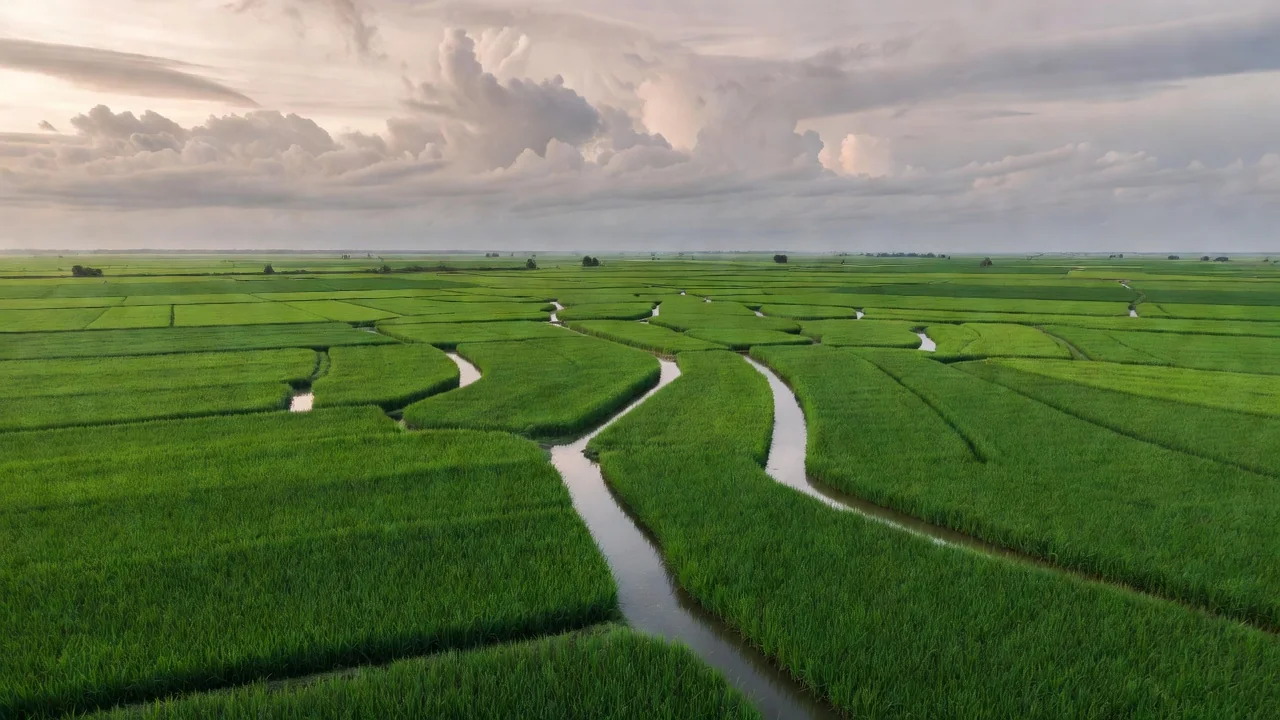
Key Stress-Tolerance Traits in Focus
National and international breeding programs, including those at the Bangladesh Rice Research Institute (BRRI) and the International Rice Research Institute (IRRI), have narrowed their priorities to four major stresses: salinity, submergence, drought and heat. Salinity-tolerant rice varieties such as BRRI dhan 67 and 78 incorporate the Saltol gene, allowing them to maintain yield when electrical conductivity reaches 8–10 dS/m. Submergence-tolerant varieties carrying the SUB1 gene can survive two weeks underwater, crucial during flash floods in the haor regions. Drought-tolerant traits focus on deeper root systems and efficient water use, while heat-tolerant lines maintain pollen viability above 35 °C during flowering.
These traits rarely occur together in nature, so breeders use marker-assisted selection to stack them into single varieties. The goal is not just survival but stable productivity under multiple stresses that often hit simultaneously in Bangladesh’s variable climate.
Speed Breeding and Modern Screening Facilities
Traditional breeding cycles that once took 8–10 years are being compressed through speed breeding. Facilities in Gazipur and Joydebpur use controlled environments with extended photoperiods and precise temperature regimes to advance up to six generations per year. Modern screening houses replicate saline, flooded and drought conditions with remarkable accuracy. Automated phenotyping platforms measure leaf temperature, chlorophyll content and root architecture without destroying plants, dramatically increasing selection efficiency.
These tools have cut the time from initial cross to farmer-ready variety from twelve years to roughly six. Yet technology alone cannot replace the knowledge held by farmers who have adapted to delta life for generations.
Diversifying Beyond Rice: Pulses, Oilseeds and Wheat
While rice dominates the landscape, Bangladesh imports over 2 million tons of pulses and 1.8 million tons of edible oil annually. Research programs are now accelerating work on lentil, chickpea, mustard and wheat to reduce this dependence. Salt-tolerant lentil lines developed through collaboration with the Bangladesh Agricultural Research Institute show promise in coastal soils where rice fails. New mustard varieties with higher oil content and heat tolerance are being tested in Barishal and Patuakhali. Wheat breeding focuses on early-maturing, heat-tolerant lines that fit into rice-wheat rotations in the western districts.
Climate models produced by the Bangladesh Meteorological Department and international partners play a central role in deciding where new varieties are tested. Downscaled projections of temperature rise, rainfall variability and salinity encroachment guide the establishment of multi-location trial sites. Varieties intended for the southern coast undergo rigorous testing in Satkhira, while those for the drought-prone northwest are evaluated around Rajshahi and Naogaon. This targeted approach ensures that released varieties match the specific challenges of each agro-ecological zone.
| Crop | Key Trait | Target Region | Expected Benefit |
|---|---|---|---|
| Rice | Salinity + Submergence | Coastal delta | Stable yield under tidal flooding |
| Lentil | Salinity tolerance | Khulna, Barishal | Additional protein crop in saline soils |
| Mustard | Heat + Drought | Southern districts | Reduced edible oil imports |
| Wheat | Early maturity + Heat tolerance | Northwest | Better fit in rice rotations |
Perhaps most important is the emphasis on adaptive research conducted directly on farmers’ fields. Participatory variety selection trials allow communities to evaluate new lines under their own management conditions, soil types and market needs. These trials often reveal that laboratory-bred tolerance does not always translate into farmer preference. Factors such as cooking quality, straw yield for livestock fodder and market price heavily influence adoption rates. When farmers participate from the earliest stages, the resulting varieties spread faster and deliver more sustainable impact.
The challenge remains immense, yet the coordinated effort across research institutes, extension services and farming communities offers genuine hope. By combining cutting-edge breeding tools with grounded, location-specific testing, Bangladesh is building a more resilient agricultural future—one field, one season, and one variety at a time.
- BRRI dhan 67 and 78 now cover over 200,000 hectares in saline zones
- Speed breeding has reduced development time by nearly 50 percent
- Farmer participatory trials increase adoption rates by 30–40 percent